
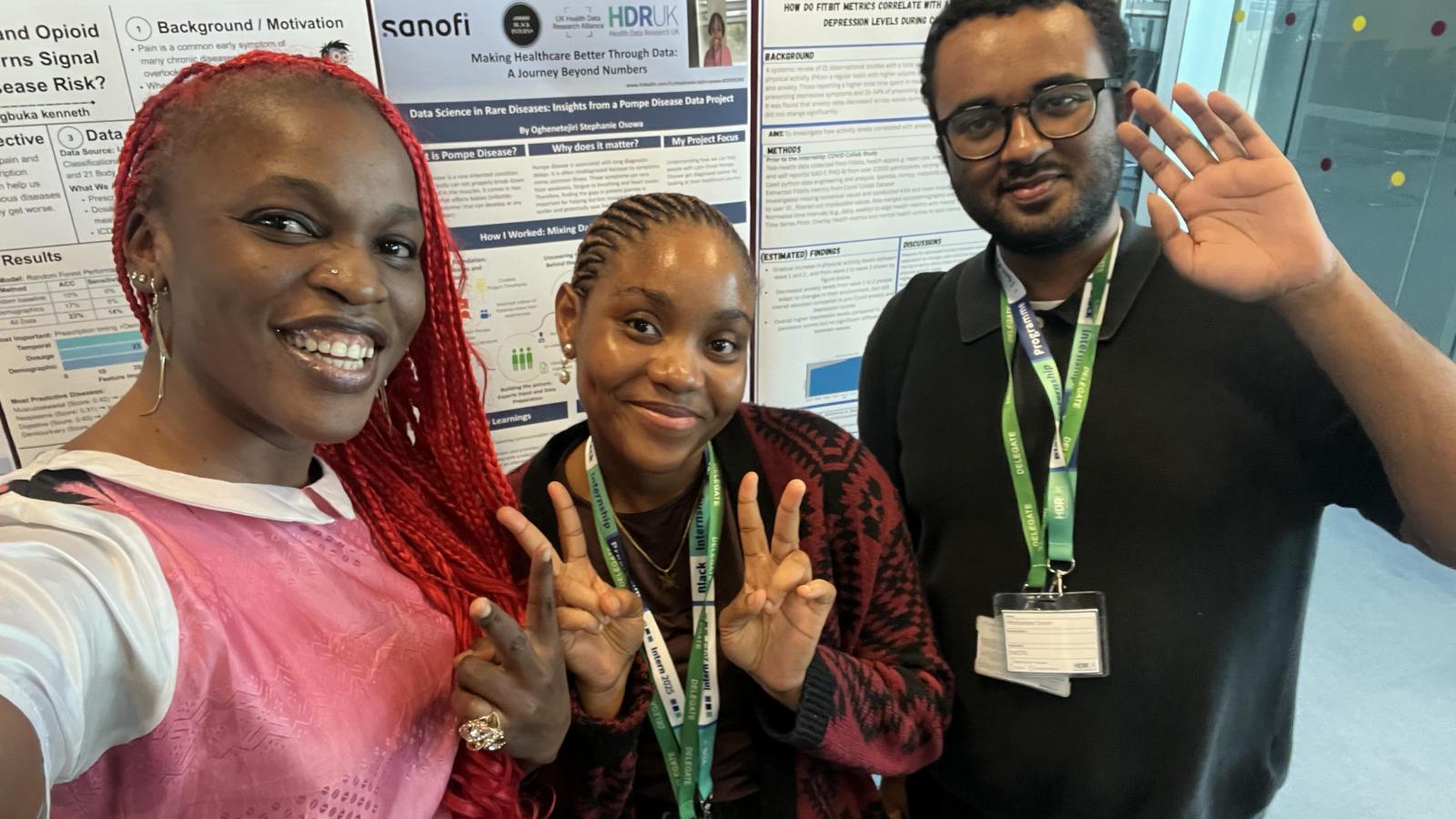
PhD Student Mary Ogbuka Kenneth joined Dr Cynthia Sandor's Lab at the UK DRI at Imperial as part of Health Data Research UK's (HDR UK) Black Internship scheme - tackling underrepresentation of Black people within the health data science sector by providing opportunities to expand knowledge and gain the experience needed to kickstart, or advance, a health data science career. In this blog, Mary discusses her experiences and the benefits from being part of this programme.
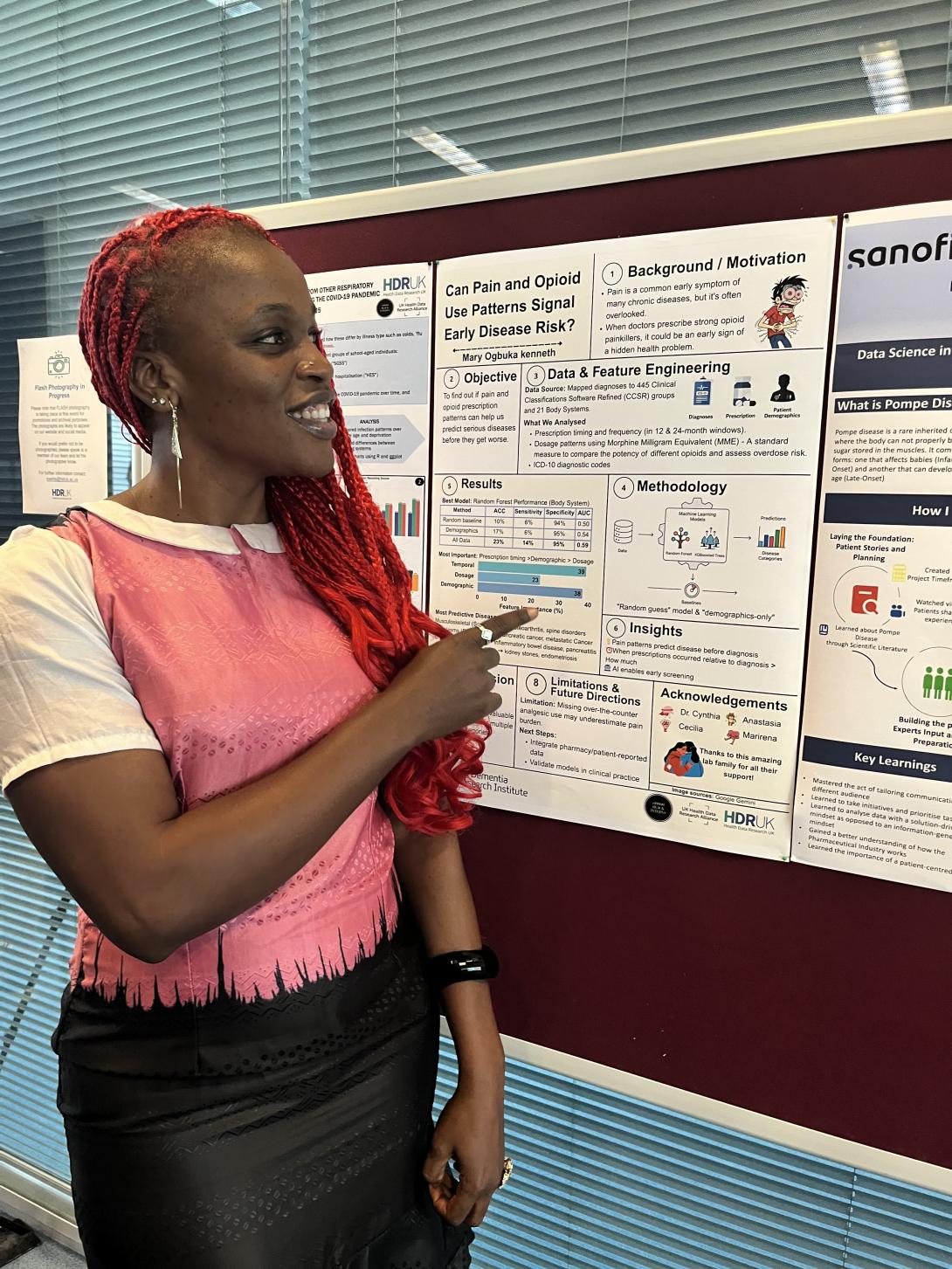
When I first stepped into the Sandor Lab at the UK Dementia Research Institute at Imperial College London as an HDR UK Black Intern, I thought I knew what to expect from data science research. After all, I was already a PhD student working on AI and machine learning. But my summer exploring ‘Pain and Opioid Use Patterns as Early Indicators of Parkinson's Disease Risk’ taught me that medical research operates by an entirely different playbook, one where explainability matters just as much as accuracy.
From Nigeria to Imperial
My journey in Computer Science began in Nigeria, where I completed my Bachelor's at Federal University, Lafia, graduating with First Class Honours. I went on to earn a Master's in Technology (MTech) in Computer Science at the Federal University of Technology, Minna.
Currently, I am pursuing my PhD in Computing at Imperial College London. My primary research sits at the fascinating intersection of AI and psychology, where I’m teaching computers to recognise different styles of humour that people use in daily life, like self-deprecating jokes versus aggressive humour, by analysing what they say, how they sound, and their facial expressions. These humour styles are linked to well-being, with some associated with better mental health and others with depression. However, for this internship, I decided to step outside the world of psychology and dive into a different, critical field: medicine.
Why health data?
I have always held a strong interest in the medical field. Given the global importance of health, the millions of data points generated daily, and the rapid advancement of technology, I knew it was time to understand how this health data is simplified and analysed for decision-making. I wanted to see how the technical tools I use for my PhD could be applied to generate insights in healthcare and improve patient outcomes.
The HDR UK Black Internship Scheme offered exactly what I was looking for: structured mentorship and access to a collaborative environment where I could explore medical AI.
The Sandor Lab
Through the Internship Scheme, I joined the Sandor Lab at the UK DRI at Imperial. My project focused on identifying patterns in pain management and opioid use that could serve as early indicators of Parkinson's risk.
My experience was both exciting and challenging. One of the highlights was meeting my new group members. Since the team consisted of PhD students and postdoctoral researchers, we shared many experiences navigating research challenges, but each brought unique perspectives from different medical and computational backgrounds, which made communication easy and natural. The weekly lab presentations were a specific highlight; they exposed me to what everyone else was working on, provided a space for mutual feedback, and gave me inspiration for how to approach my own research.
I was also fortunate to be guided by my internship supervisor, Dr Cynthia Sandor, who was incredibly supportive throughout the process. Our weekly meetings were exciting because she provided feedback that pushed me to think more deeply and rigorously about my experiments.
Moving Beyond "Black Box" Metrics
The most significant learning curve I faced was interpreting my findings. In the general field of Machine Learning (ML), the workflow is often straightforward: clean the data, feed it to the model, and report performance metrics like Mean Squared Error (MSE) or accuracy.
During this internship, I realised that high accuracy is only one part of the puzzle in medical research. Equally important is explainability, understanding why the models used make the decisions they did and identifying which variables were most influential. This insight shifted my approach. Before feeding them into the model, I had to examine the relationships among data points even before feeding them to the model. This required using statistics to better understand these relationships. As I was not initially familiar with these specific statistical methods, it challenged me to read more about when and how to apply them, deepening both my technical skills and my appreciation for rigorous data exploration.
Key Takeaway & Future Goals
My main takeaway from the scheme is that the first insight you get may not show the full picture. A result might be by chance or influenced by hidden variables. Therefore, it is critical to perform statistical analysis to ensure your findings are significant, especially in high-stakes fields like medicine.
Looking ahead, I plan to complete my PhD at Imperial. After that, I aim to pursue a career as an AI researcher in the health sector, applying these lessons to real-world medical challenges to improve patient outcomes.
For anyone considering a similar path, I highly recommend the HDR UK Black Internship Programme. It has helped me shaped my skills and perspective, and I’m grateful for the opportunities it has provided.