In 2025, the UK DRI partnered with Parkinson’s UK to launch a new £10m research centre dedicated to better understanding the causes of Parkinson’s and finding urgently needed treatments for the condition. Following a competitive process, we are delighted to announce the first Group Leader appointments to the Parkinson’s Research Centre.
Prof Miratul Muqit was recruited to lead as Centre Director with a vision to build a centre fully integrated with people with Parkinson’s, which will become one of the world’s leading centres for discovery science and translation, and deliver new ideas for better diagnosing and treating Parkinson’s in the future.
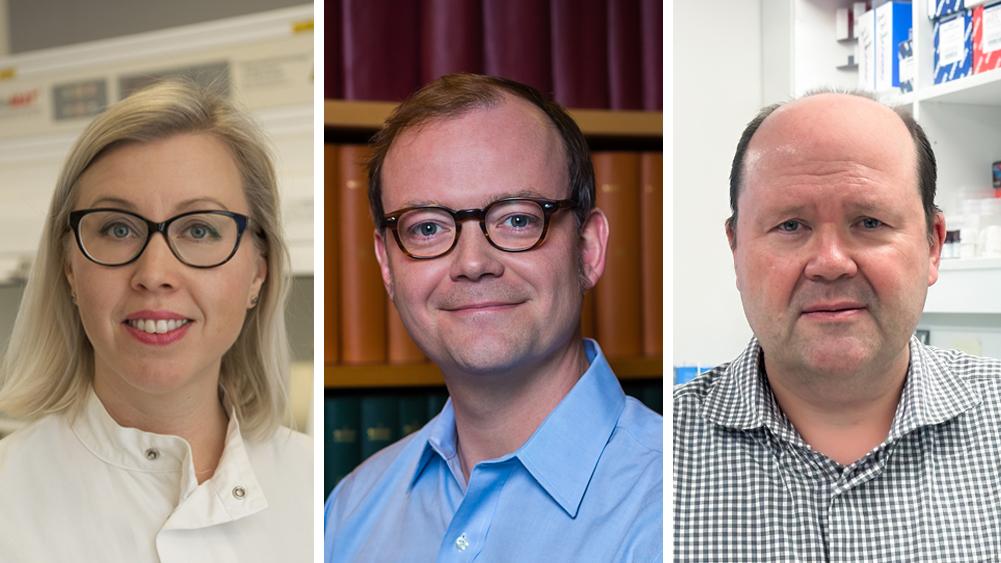
(Left-right) Professors Laura Parkkinen, Peter Magill and Henry Houlden
Following an international call, three of the UK’s leading Parkinson’s researchers have been appointed to UK DRI Group Leader roles:
- Prof Laura Parkkinen (University of Oxford) – Next-generation human neuropathology to decode the mechanisms that drive Parkinson’s
- Prof Peter Magill (University of Oxford) - Investigating the molecular and cellular substrates of neural circuit dynamics in Parkinson’s
- Prof Henry Houlden (UCL) - Investigating the genetics of Parkinson’s and degenerative movement disorders across diverse global populations
Together their programmes unite gene discovery, fundamental circuit neuroscience and brain biomarkers to accelerate earlier diagnosis and more precise therapies for Parkinson’s and related disorders. Read more about them below.
“I am thrilled to welcome Professors Parkkinen, Magill and Houlden, to the Parkinson’s Research Centre. Their complementary expertise and rigorous approach to identifying and understanding new mechanisms in Parkinson’s significantly bolsters our ambition for the Centre to focus on the most challenging questions on the origins of Parkinson’s. Through collaboration, we will drive our research discoveries towards delivering for people with Parkinson’s, a key mission of the Centre. I look forward to working with them and sharing our research vision with the wider community at the formal launch of the Centre later this year.”
The new Group Leaders were selected through a highly competitive international recruitment process. An expert panel - chaired by UK DRI Director Prof Siddharthan Chandran and comprising UK DRI and Parkinson's UK leadership, and a patient representative, Shafaq Ali - conducted the interviews, alongside senior university representatives from each host institute.
Shafaq, who brought her lived experience of Parkinson’s to the appointment panel, said:
“It was a privilege to be involved in this recruitment process. The new Centre recognises that Parkinson’s research cannot happen without the involvement and participation of the Parkinson’s community. By involving me in the recruitment process, they proved it is a core value they hold from the start. To be able to hear from the Group Leaders, and Miratul himself, of their passion and plans for involvement and transformative research has filled me with hope about what is to come.”
Prof David Dexter, Director of Research at Parkinson’s UK, said:
“This is another milestone in the establishment of the Parkinson’s Research Centre. We set out to find the best minds to tackle the growing global problem of Parkinson’s and I’m thrilled that we’ve been able to secure high calibre scientists, in a very competitive process. Each has their specific areas of expertise, which will come together under Miratul’s leadership, to speed up life changing research into new insights and life changing treatments for Parkinson’s.”
Group Leaders
A deeper dive into the research programmes of the first three Group Leaders at the Parkinson's Research Centre.
- Prof Laura Parkkinen, PhD (University of Oxford)
“There’s no shortcut to finding new Parkinson’s treatments. We need to understand why certain brain cells develop pathological alpha-synuclein aggregates - and how to stop this. I’m really excited to be part of the UK DRI. These are also incredibly exciting times in the field of translational neuropathology, where we are now able to combine advanced molecular and protein-mapping techniques to explore the human brain in ways that were never possible before. I’m confident that this is where the next breakthroughs in Parkinson’s drug discovery will emerge.”
Next-generation human neuropathology to decode the mechanisms that drive Parkinson’s disease
Prof Laura Parkkinen joins the UK DRI from the University of Oxford, where she will maintain a full-time position as Professor of Translational Neuropathology and Director of the Oxford Brain Bank. Through pioneering research in human neuropathology, she has dedicated over 20 years to advancing our understanding of Parkinson’s and related dementias, including dementia with Lewy bodies. Her lab is internationally recognised for its expertise in bridging molecular neuropathology with biomarker discovery. Her group was amongst the first to develop the highly sensitive RT-QUIC assay detecting alpha-synuclein seeding activity in cerebrospinal fluid that is now being tested worldwide in people living with Parkinson’s. The Parkkinen Lab studies how the Lewy bodies and alpha-synuclein protein aggregates disrupt cells and eventually lead to neurodegeneration in the condition. The team aims to unravel cellular mechanisms underpinning selective vulnerability, alpha-synuclein aggregation and seeding and clinical heterogeneity in order to discover new drug targets and therapies for Parkinson’s.At the UK DRI, Prof Parkkinen will pursue molecular-based research on human brain samples of Parkinson’s and related disorders. Her group will integrate digital pathology, laser microdissection and RNA and protein sequencing methods to better understand mechanisms governing dopamine neuron vulnerability and the role of other brain cell types in this process. This will advance new methods for pathological diagnosis and classification as well as drive new therapeutic ideas.
- Prof Peter Magill, DPhil (University of Oxford)
“I am thrilled to be joining the Parkinson’s Research Centre and to have the opportunity to contribute to the delivery of its distinctive vision. I look forward to collaborating with new colleagues at the Centre and across the UK DRI as we work together with our charity and public partners to fully realise the benefits of transformative research and make a difference to the lives of people affected by Parkinson’s.”
Investigating the molecular and cellular substrates of neural circuit dynamics in Parkinson’s
Prof Magill is Professor of Neurobiology, Aligning Science Across Parkinson’s (ASAP) Co-Investigator, and Director of the MRC Brain Network Dynamics Unit at the University of Oxford. He is also founding Director of the MRC Centre of Research Excellence in Restorative Neural Dynamics. Prof Magill’s research is focused on elucidating the operational principles of the basal ganglia and partner brain circuits in both health and neurodegenerative conditions. He and his team have pioneered the use of animal models to identify the molecular, cellular and circuit mechanisms that underlie moment-to-moment fluctuations of nerve cell activity in the brain in vivo and how these go awry in Parkinson’s. Their work has helped explain how disturbed brain rhythms arise in Parkinson’s and cause movement difficulties, how different nerve cell types fulfil specialised functions to control complex behaviour, and how the signalling of the most vulnerable nerve cells in Parkinson’s is altered in the living brain by diverse disease burdens.
At the UK DRI, Prof Magill will advance fundamental research into the molecular circuit mechanisms underlying Parkinson’s. His studies will integrate molecular science with pre-clinical models to identify relevant mechanisms of neuronal vulnerability and which will identify and guide principles for the development of therapeutic approaches in Parkinson’s.- Prof Henry Houlden, MD, PhD, FRCP, FMedSci (UCL)
“I am grateful to be part of the Parkinson’s Research Centre. This will help our team to understand the genetic spectrum of Parkinson’s disease and other movement disorders across all populations. We are very collaborative and look forward to working with new colleagues across the UK DRI. The ultimate aim will be to translate these discoveries into improved diagnostics, more personalised approaches to care and identify novel therapeutic targets that can meaningfully improve the lives of patients and families affected by these disorders.”
Investigating the genetics of Parkinson’s and degenerative movement disorders across diverse global populations
Prof Henry Houlden is Professor of Neurology at the UCL Queen Square Institute of Neurology and a globally recognised leader in neurogenetics. He has defined the genetic basis of numerous neurological disorders, including Parkinson’s disease and other movement disorders, and was elected a Fellow of the Academy of Medical Sciences in 2023 in recognition of his contributions to the field.
The Houlden Lab focuses on Parkinson’s disease and degenerative movement disorders, including multiple system atrophy (MSA), with a commitment to studying the full spectrum of patient populations across diverse ethnic and geographic backgrounds. Through extensive international collaborations, the team has generated major clinical, genetic and biomarker advances. Their work has led to the identification of multiple disease-causing genes, the discovery of novel biological pathways, the development of new diagnostic approaches, and significant progress in defining genetic risk. The lab has also led several international genome-wide association studies (GWAS), uncovering key susceptibility loci in Parkinson’s disease, MSA and related disorders.
Prof Houlden played an instrumental role in the 100,000 Genomes Project, coordinating one of the world’s largest cohorts of neurological disease genomes and representing rare diseases on the Genomics England board. He is now leading the development and implementation of long-read DNA and RNA sequencing technologies in both research and diagnostic settings, with the aim of transforming the management of inherited neurological disorders.
At the UK DRI, Prof Houlden will continue to expand this work by mapping the genetic architecture of Parkinson’s disease and atypical parkinsonism across the UK, while strengthening international partnerships to accelerate disease gene discovery, large-scale GWAS, biomarker development and translational progress.
Parkinson's Research Centre
Find out more about the dedicated Parkinson's Research Centre established by the UK DRI and Parkinson's UK.