

Dr Soraya Meftah is a UK DRI postdoctoral researcher, and Race Against Dementia Fellow. Here, she shares her experience of attending the Women in Neuroscience UK Annual Awards event.
The Women in Neuroscience UK (WiN UK) awards evening on 7 November 2025 in London, was an opportunity to celebrate women and allies for their contributions to the neuroscience community and beyond. The annual event honours pioneering women scientists, cutting-edge research in sex and gender, and dedicated advocates for more inclusive neuroscience workplaces.
As the UK's first organisation dedicated to empowering female neuroscientists, inclusion is at the heart of WiN UK's mission. This commitment extends to all women, girls, and individuals across the trans, genderqueer, and non-binary spectrum who are passionate about neuroscience.
The evening was a powerful tribute to those pushing boundaries and driving progress in environments not always designed for their success, aligning with their mission to inspire, connect and advocate for gender equity in neuroscience. There were over 150 nominations for the awards, testament to the amazing neuroscience community in the UK.
At the start of the evening, founder Dr Lizzie English highlighted some of the stark challenges facing female neuroscientists. For example, there is a significant lack of recognition for the work of women across STEM – between 1901 and 2019 only 3% of scientists recognised by the Nobel Prize Committee were women (21 out of 600) (Link 1). There is a known ‘leaky pipeline’ in academia, with female representation significantly lower at senior levels: in the UK, in 2021 47% of academic staff were female, but only 28% were at professor level (Link 2), (Link 3). In dementia research, male researchers were awarded ~63% of grants for major projects (i.e. for senior researchers) between 2000-2020 (Link 4). Yet, the event served as a powerful and positive counter-narrative to these facts, choosing to celebrate the profound achievements being made and how the community is changing.
There were inspiring key notes from Prof Selina Wray and Dr Carole Torsney. Selina discussed her career journey, coming from a working-class background, to becoming a professor running a world-leading dementia research group. She highlighted the role of mentors and supporters that have helped her on this journey. It was insightful to hear her own career reflections and the features that were key in supporting her journey.
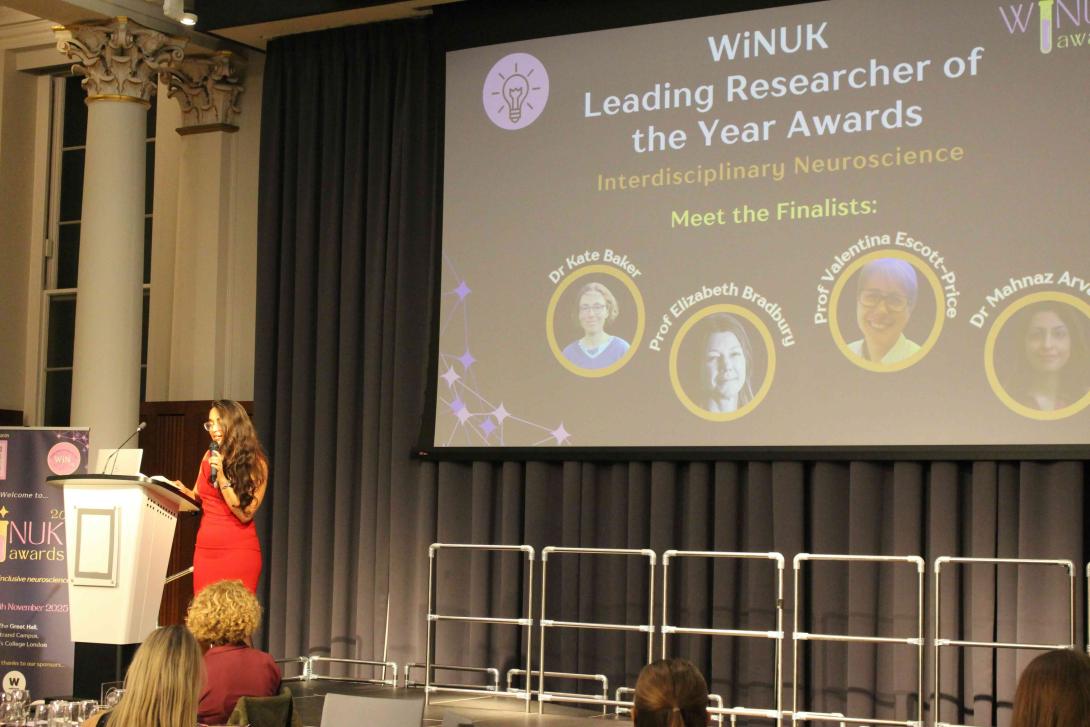
The award ceremony took place at The Great Hall, King’s College London on 7 November 2025.
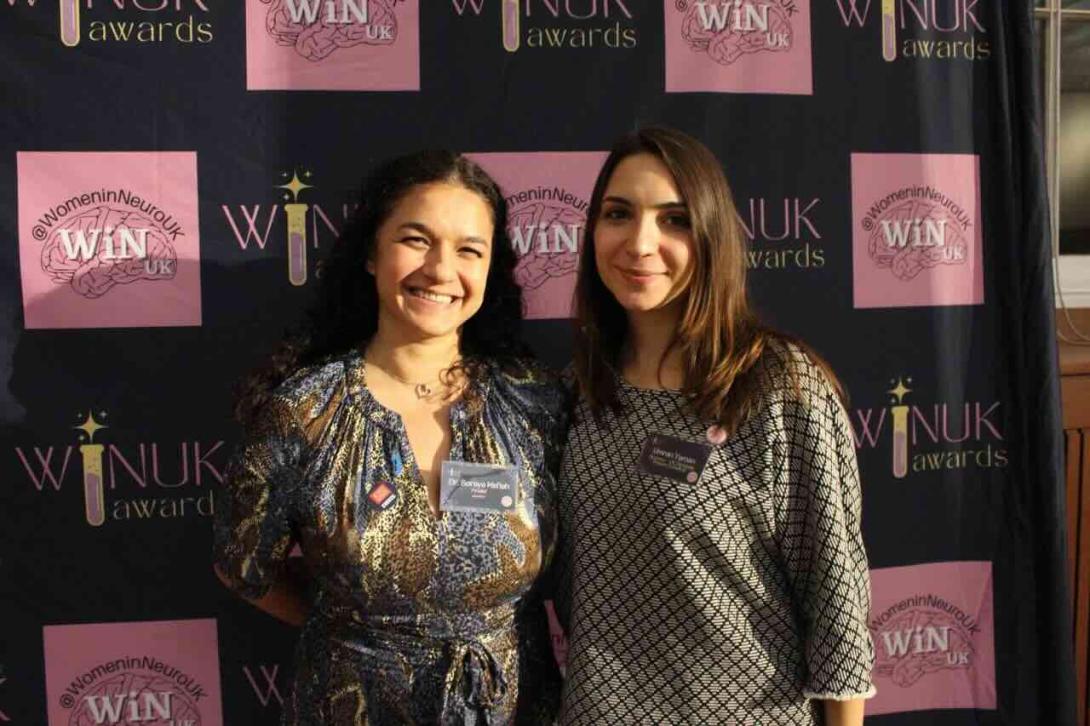
UK DRI’s Dr Soraya Meftah and Dr Ümran Yaman attended the evening event
Carole highlighted key research on the differences between female and male pain neurobiology. She highlighted that chronic pain is more prevalent and severe in women (Link 5), (Link 6), yet between 1996-2005 80% of pre-clinical pain research studies were performed on men only, and only 4% of pain research compared between the sexes. This was still the case up until 2017 with progress towards a more equitable distribution seen in more recent years (Link 7). She described findings from her own research, observing stark differences in pain responses between sexes, likely via different biological mechanisms (Link 8).
The evening would not have been possible without sponsorship which included the Wellcome Trust, the Transmitter, Alzheimer’s Research UK and our very own UK DRI, which sponsored the Sex/Gender in Neuroscience award given to those who have demonstrated the importance of understanding sex/gender implications in their research. This award was won by Prof Ruth Dobson (Queen Mary University) whose research focuses on the role of ethnicity, deprivation, gender, and wider social determinants of health in multiple sclerosis, and has led the publication of guidelines on pregnancy in multiple sclerosis.
From the UK DRI, nominees included Dr Soyon Hong for Neuropathology and Ageing, Prof Valentina Escott-Price for Interdisciplinary Research, Dr Puja Mehta for Rising Star Postgraduate Researcher, Dr Soraya Meftah for Rising Star Postdoctoral Researcher and Dr Wioleta Zelek and Dr Claire Durrant as Rising Stars in the Early Career Group Leader category.
Prof Valentina Escott-Price (UK DRI at Cardiff) won the award for Interdisciplinary Research. As a researcher, she develops methods that identify weak signals of disease genes and biological pathways and systems and applies this to genetic brain disorder datasets including neurodegenerative diseases. It is incredible that we have such talented scientists within the UK DRI that have been recognised for their contributions.
For me, as one of the co-chairs of the UK DRI Diversity, Equality and Inclusion Think-Tank, a grass-roots initiative that aims to actively champion and celebrate diversity, promote inclusion, and strive for equality, I see this as not just something that impacts women. These challenges are further exacerbated by systemic inequalities, such as those based on race, class, and disability. Whilst striving for equality is the right thing to do, we also know it drives innovation, which is very much needed in the field of dementia research and is at the heart of the UK DRI.
Overall, it was a really empowering evening and it was so impressive to be sharing a room with women and allies that are all united in supporting gender equity in neuroscience. It fostered a strong sense of community, and I look forward to seeing where we progress across STEM research in the coming years.