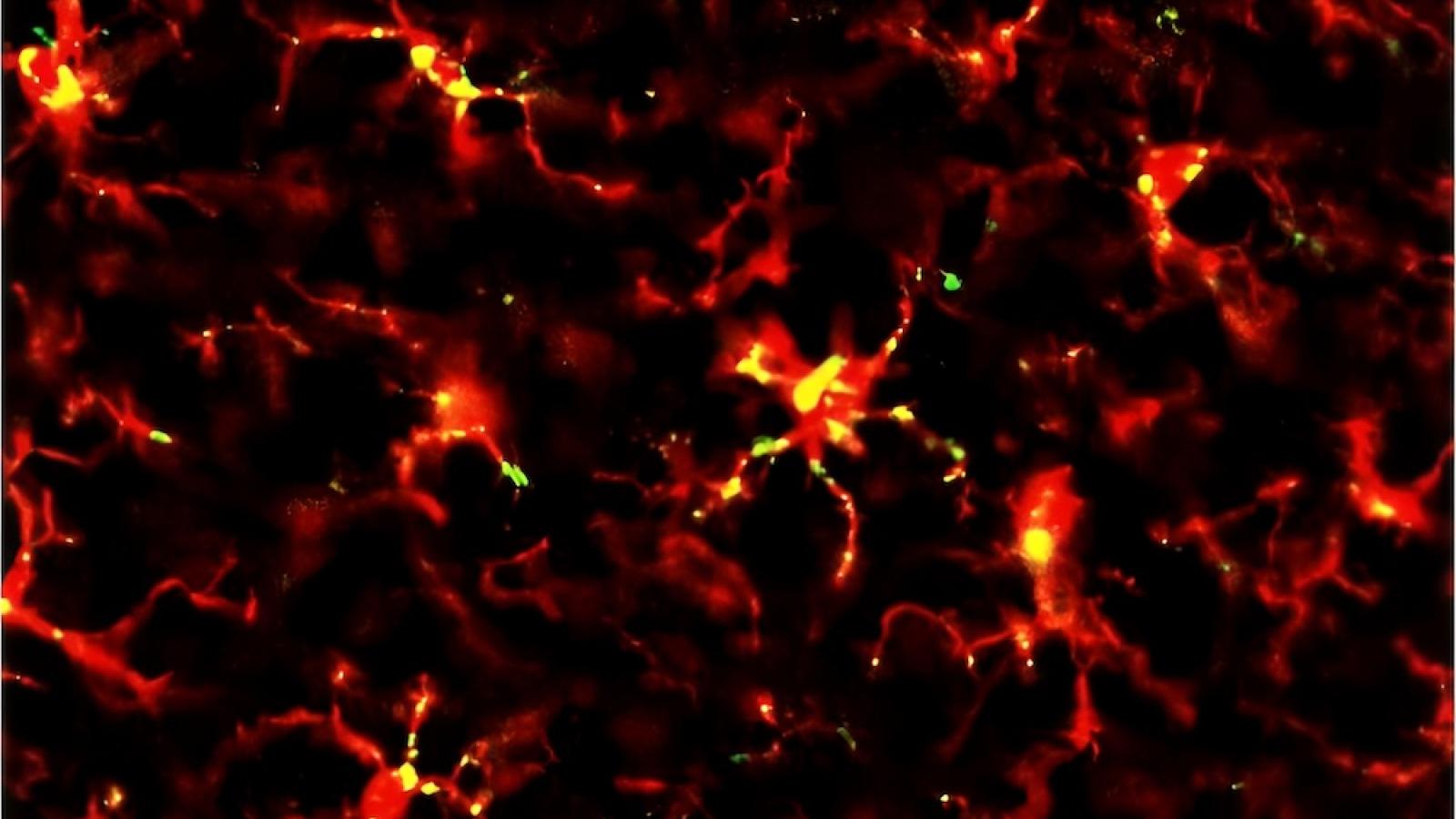
In a new study, first author Sarina Grewal in Dr Sophie Morse’s group (UK DRI at Imperial) showed that ultrasound can non-invasively reduce brain inflammation by modulating the activity of microglia, the brain’s resident immune cells. The paper, published in npj Acoustics, suggests that therapeutic effects are largely dependent on the exact frequency of ultrasound and its acoustic pressure.
What was the challenge?
Neuroinflammation contributes to the progression of several neurodegenerative conditions, including Alzheimer’s and Parkinson’s. Although inflammation starts as a protective response, sustained disruption to microglia’s activity can disrupt the brain’s carefully balanced environment. When activated, microglia release signalling molecules that induce inflammation, such as tumour necrosis factor-alpha (TNF-α), interleukin-1β (IL-1β) and interleukin-6 (IL-6), and these can cause damage to the surrounding tissue. Existing treatments cannot reduce this inflammation without having an effect on other parts of the immune system, which leaves patients vulnerable to infection and other complications. As a result, there is growing interest in safe, non-invasive ways to reduce microglial activation to a normal level.
However, it has been unclear exactly which ultrasound parameters should be used to achieve this. Researchers have undertaken studies at a range of frequencies, with different pressures and treatment times, making it difficult to compare results or design reproducible therapies.
What did the team do and what did they find?
To address this, the Morse Lab systematically screened 27 different combinations of centre frequency, acoustic pressure and treatment duration in microglia in a dish that had been placed into a state of inflammation. They found that delivering ultrasound at 0.5 MHz at 0.2 MPa for five minutes produced significant and sustained benefits. Levels of the inflammatory signalling molecules remained lower for at least 72 hours after treatment, and gene analysis suggested this was linked to the NF-κB signalling pathway, a key regulator of inflammation. Conversely, at the same time, expression of anti-inflammatory genes IL-10 and IL-4 was increased. The ultrasound reduced markers of cell toxicity, and temperature rises in the tissue were negligible.
Sarina and the team then tested the same parameter set in mouse models that mimicked sustained brain inflammation. Just four hours after a single whole-brain ultrasound session, with just 6 seconds of ultrasound, TNF-α levels were significantly reduced in the hippocampus, a region particularly vulnerable to damage by inflammation. The microglia also began to regain their normal, highly branched structure. The researchers also observed increased activity within the cells’ lysosomes – the cell’s recycling centre - suggesting they were priming themselves to clear cellular debris, and indicating the cells were returning to a normally functioning state.
Reducing brain inflammation without suppressing the rest of the immune system is an ongoing clinical challenge. Our study shows that ultrasound could be the answer: it is entirely non-invasive, safe, and painless, and allows targeted treatment of brain inflammation while allowing immune cells elsewhere in the body to function as normal. This could be a viable treatment option to reduce brain inflammation in neurodegenerative conditions such as Alzheimer’s and Parkinson’s.
Emerging Leader
What is the impact?
The findings add to a growing body of evidence suggesting that ultrasound could become a non-invasive treatment for neuroinflammatory conditions. A key takeaway is that careful fine-tuning of ultrasonic parameters such as frequency, acoustic pressure and treatment duration will be essential if the technology is to be used to treat patients. In future studies, the Morse Lab plan to test the approach in disease-relevant models and human microglia models. This work could eventually allow clinicians to tailor ultrasound protocols to specific diseases, and potentially to individual patients.
Reference: Grewal, S., Iacoponi, F., Chan, L.Y.N. et al. Ultrasound modulates microglial activity and reduces neuroinflammation in a parameter-dependent manner. npj Acoust. 2, 15 (2026). https://doi.org/10.1038/s44384-026-00047-8
Banner image: Microglia, the brain's immune cells after ultrasound treatment. Credit: Sarina Grewal, Morse Lab