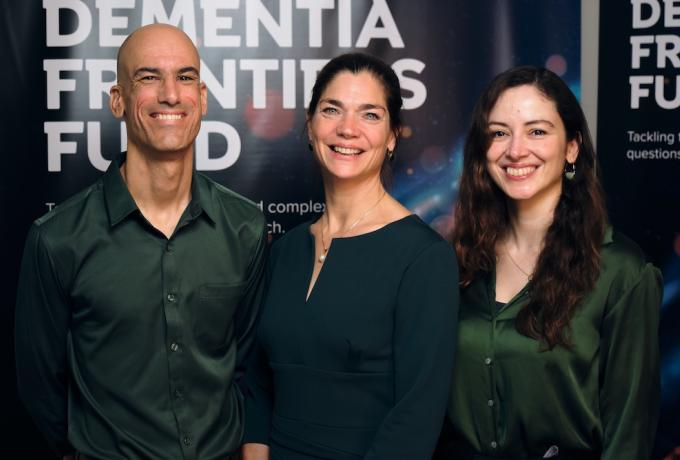
An international team led by Dr Sarah Marzi (UK DRI at King’s), with Dr Alexi Nott (UK DRI at Imperial) and Professor Henne Holstege (Amsterdam UMC and VIB-KU Leuven Center for Neuroscience) has won £1.5 million from the Dementia Frontiers Fund, a global initiative launched by Gates Ventures and Alzheimer’s Research UK (ARUK).
The team was selected from an initial field of 132 teams across 29 countries, emerging as one of five winners after a competitive, staged review process. While most dementia research asks what causes the disease, EMERALD (Epigenomic Mechanisms of Extreme Resilience and APOE Liability in Dementia) takes the opposite approach, asking how people can reach very old age while avoiding it.
Centenarians who resist dementia
Dementia affects over 55 million people worldwide, with numbers projected to nearly triple by 2050. Most cases are caused by Alzheimer’s disease, which is driven in part by amyloid-beta, a protein fragment that occurs naturally in the brain. In Alzheimer’s, it misfolds and clumps into sticky plaques between neurons, one of the disease’s two hallmark abnormalities, alongside tau tangles.
A fundamental gap in the field is our limited understanding of why some individuals, even those carrying high-risk genetic variants or accumulating substantial neuropathology, maintain cognitive function into extreme old age.
Research suggests that around 60% of the ability to reach 100 with preserved cognition is heritable, and that centenarians carry more protective gene variants linked to Alzheimer's, pointing to a strong genetic role in this resilience.
Studies of the 100-plus Study, the world’s largest cohort of cognitively healthy centenarians (people who reach over 100 years in age), show that they achieve this protection in one of two ways: some avoid accumulating amyloid pathology altogether (resistance), while others accumulate amyloid but keep an unexpectedly low burden of tau tangles, and so remain cognitively intact despite that pathology (resilience).
In these centenarians, the normal chain reaction (amyloid triggering tau, and tau driving cognitive decline) appears to be interrupted. Understanding how that interruption happens at the level of brain cells is precisely what EMERALD sets out to map.
EMERALD’s challenge
“Our project addresses the question of how some individuals at high risk remain resilient to dementia. We will be looking at the brains of centenarians to understand what protects them against neurodegeneration,” said Dr Sarah Marzi, UK DRI Group Leader, and Senior Lecturer in Neuroscience at King's College London.
“Despite major advances in understanding Alzheimer’s disease genetics and pathology, we still don't know why some high-risk individuals remain cognitively healthy while others develop dementia,” said Dr Alexi Nott, Associate Professor at the Department of Brain Sciences, Imperial College London, and UK DRI Group Leader.
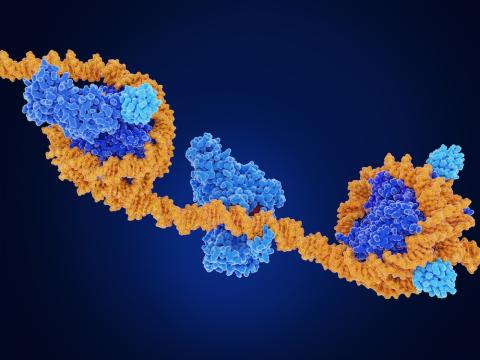
The team will use centenarian brains from the 100-plus Study. They will study epigenetic signatures (biological mechanisms that regulate the expression of genes) across four brain cell types – neurons, microglia, astrocytes and oligodendrocytes – to understand how the cells of cognitively healthy centenarians differ from those of individuals with dementia.
This will allow them to map how protective genetic variants, cell-type-specific gene regulation, and acquired immune mutations converge to interrupt the amyloid-tau-dementia cascade.
“By understanding how resilient brains resist or tolerate pathology, we hope to identify new therapeutic targets to prevent or delay dementia in younger populations,” said Dr Marzi.
The project will address three interconnected challenges: identifying the regulatory programmes that protect resilient brains; understanding how inherited genetic protection is implemented at the cellular level; and determining whether acquired mutations in the immune system reinforce that protection.
Future impacts
“These insights could transform dementia research from a disease-focused to a resilience-focused paradigm,” said Dr Nott. “By identifying molecular programmes that distinguish resilient from vulnerable brains, EMERALD will provide candidate biomarkers for early detection and risk stratification, reveal regulatory pathways that could be targeted therapeutically, and clarify how protective genetic architectures could be reinforced.”
Ultimately, this research could enable interventions that preserve cognition by strengthening the brain’s own protective mechanisms.
“Our project spans all the way from identifying such mechanisms in the brains of centenarians to testing them in the laboratory, with the long-term goal of enhancing protective mechanisms in those at risk of dementia,” concluded Dr Marzi.
Links
- Source: Imperial College London. Also published at King's College London.
- Alzheimer’s Research UK, https://www.alzheimersresearchuk.org/research/for-researchers/dementia-frontiers-fund/