
Earlier this month, UK DRI researchers welcomed thousands of visitors at the Great Exhibition Road Festival on Imperial College London's South Kensington campus, to explore how cutting-edge science is transforming our understanding of the brain and supporting people living with neurodegenerative conditions.
Marking 175 years since the original Great Exhibition of 1851, the festival was the largest to date. Around 57,000 visitors attended across the weekend, with over 100 teams from Imperial sharing their work through talks, interactive exhibits, workshops and demonstrations.
The UK DRI was represented across three stands, each offering hands-on activities that brought the latest research to life for the public.
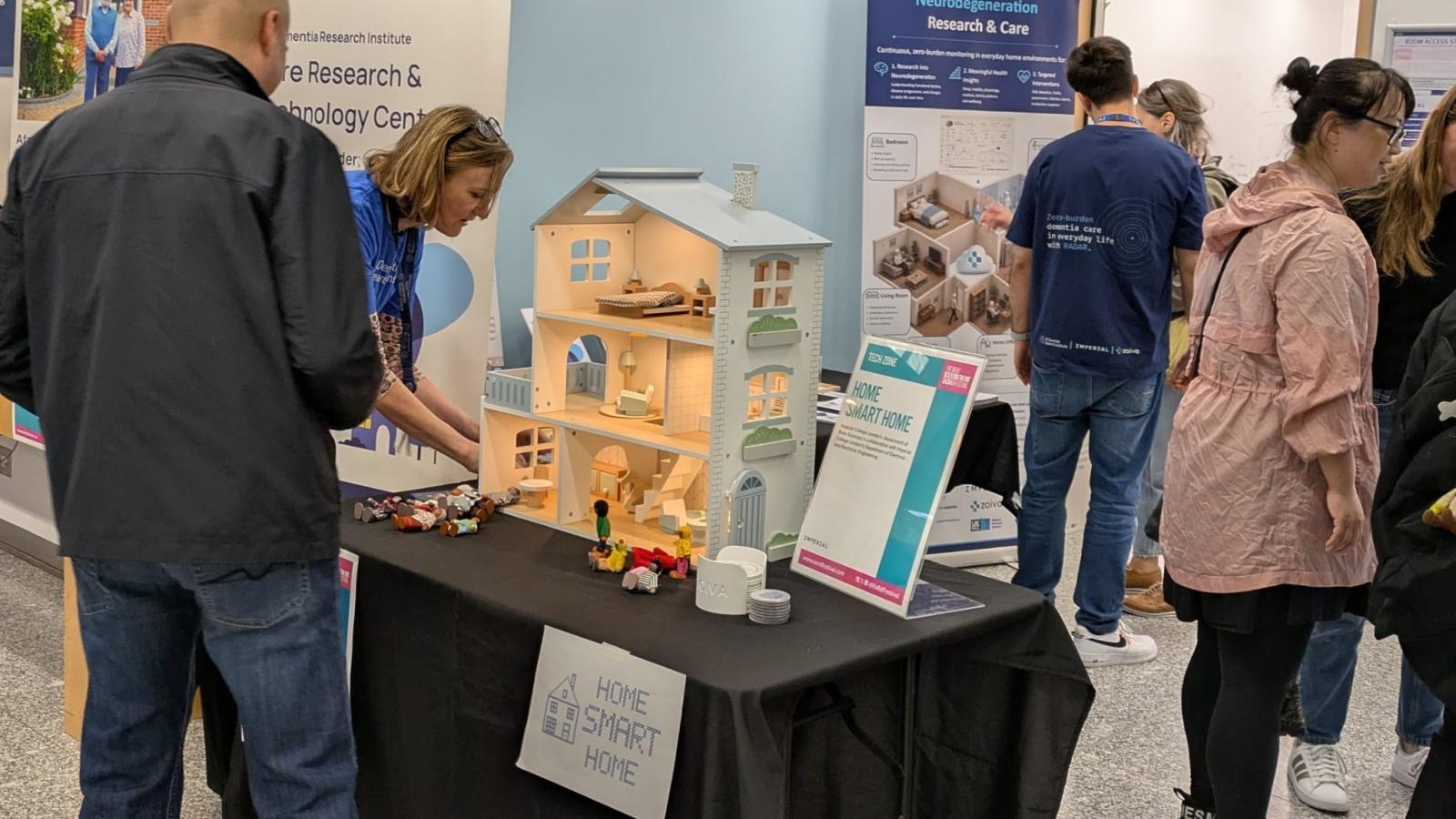
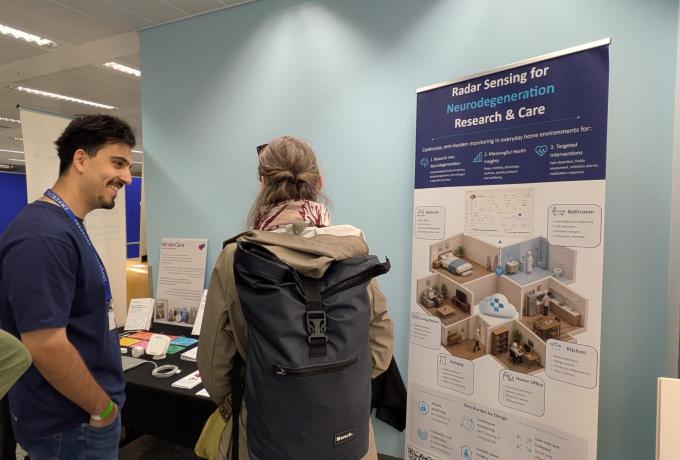
At the Care, Research and Technology (CR&T) centre stand, the MinderCare and Radar teams demonstrated how digital technologies can support people living with dementia through proactive home monitoring. Visitors explored interactive exhibits showing how sensors and radar can track daily routines, movement, sleep, and early signs of illness without being intrusive. Activities included a mini smart-home installation, a communal timeline of daily routines, and discussions around the benefits and ethics of remote monitoring. The Radar team also showcased a body-controlled Pong game, illustrating how contactless sensing can detect health changes and help prevent unnecessary hospital admissions.
Dr Mara Golemme, Scientific Project Manager, said:
"We were delighted by the level of interest and enthusiasm from visitors at GERF 2026, with people of all ages engaging with our work and exploring how technology can support people living with dementia. It was fantastic to see so many meaningful conversations sparked by our interactive exhibits. A huge thank you to everyone across the MinderCare and Radar teams at CR&T, who dedicated their time, energy, and expertise to making the weekend such a success."
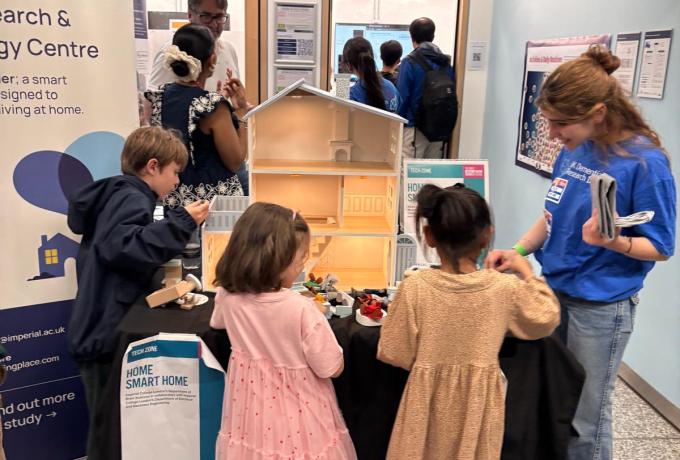
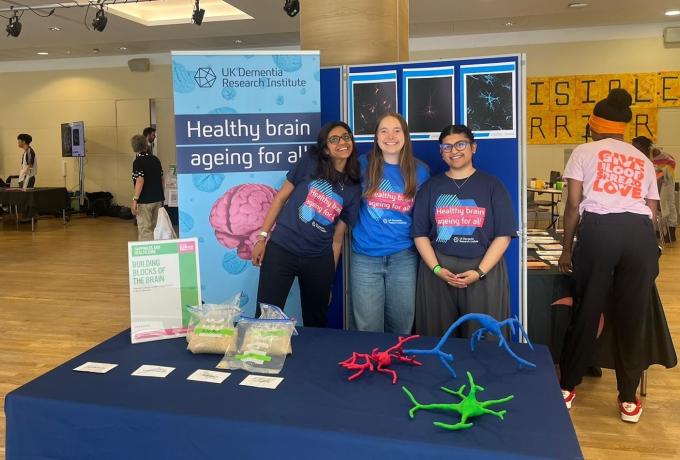
The UK DRI at Imperial had two stands, led by Dr Anna Mallach and Dr Cynthia Sandor. Vistors to the Mallach Lab stand took part in two activities designed to challenge common assumptions about the brain. In one, guests were asked to guess the weight of four brains, represented by bags of rice, and guess which animal they came from. The purpose was to demonstrate that organism size is not representative of brain size, and that the complexity of an organism's functions determines brain weight.
The second activity invited visitors to match diagrams of different brain cell types to microscopic images. Starting with the neuron, the most commonly known cell, the team introduced astrocytes, microglia and other cell types, illustrating how cells look different in two and three dimensions and how microscopy is used to study the brain. The stand demonstrated that we have more cells in the brain than neurons alone, and that these cells each have different functions and appearances.
At the Sandor Lab stand, titled "Beyond Movement: Decode Parkinson's", the team showed festival attendees that Parkinson's is more than a movement disorder. Visitors tried a smartwatch challenge, to experience how wearables detect early autonomic changes, and tested their sense of smell to learn about hyposmia as an early sign of Parkinson's.
Cynthia Sandor said:
"One of the most powerful moments was showing visitors that walking and running may look similar to the naked eye, but the wearable signal tells a completely different story. Seeing their own data change in real time made people realise that these devices can pick up subtleties in movement that we simply cannot see. And that is exactly where the opportunity lies for Parkinson's: the changes in how people move often appear long before any obvious symptoms, and a smartwatch worn every day could be the tool that catches them first."
Each year, the festival is a valuable opportunity for UK DRI researchers to share their work with the public, break down barriers between scientific institutions and the communities they serve, and inspire the next generation of scientists in London.