Using engineering, physics and neurobiology to investigate the interplay between the shape and structure of a cell and its function
Cells are have been shaped by evolution to have a specific architecture. Some, like neurons have a long projection, the axon, which connects parts of the body that are sometimes metres away. Factors such as the length, size and shape of a cells can impact their biology in significant ways, and for neurons a significant part of the RNA biology and the molecular mechanisms that are involved in diseases such as MND and FTD happen away from the main cell body.
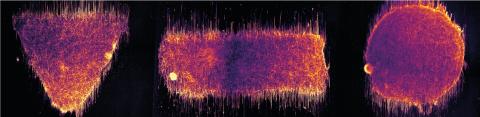
The Serio Lab uses engineering, physics and neurobiology to investigate the interplay between the shape and structure of a cell and its function. In doing so, they hope to better understand the processes in MND/ALS that lead to the death of neurons.
Latest news
Dr Andrea Serio
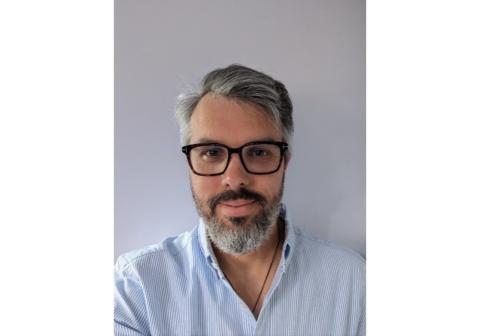
Dr Andrea Serio is a Group Leader at the UK DRI at King's. Find out more about his career and expertise on his profile page.

Research summary

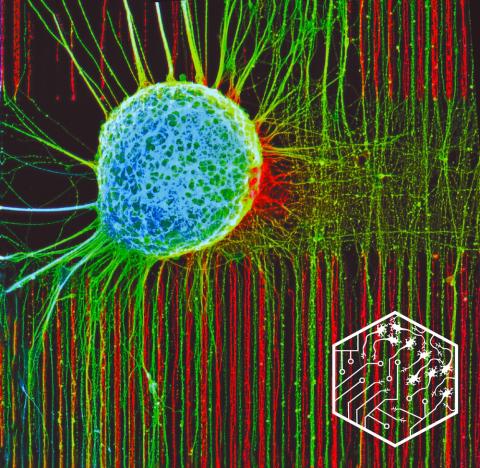
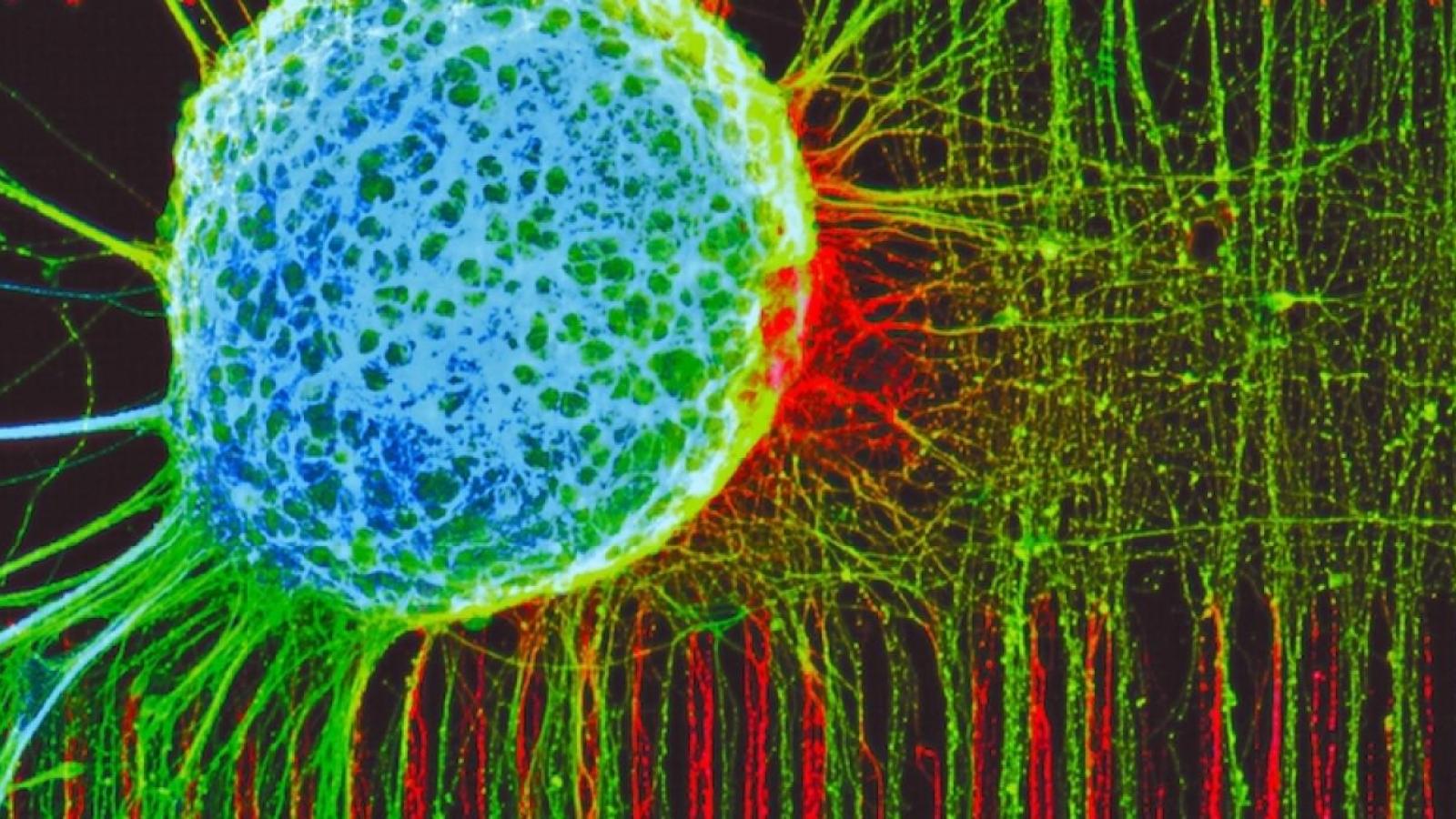
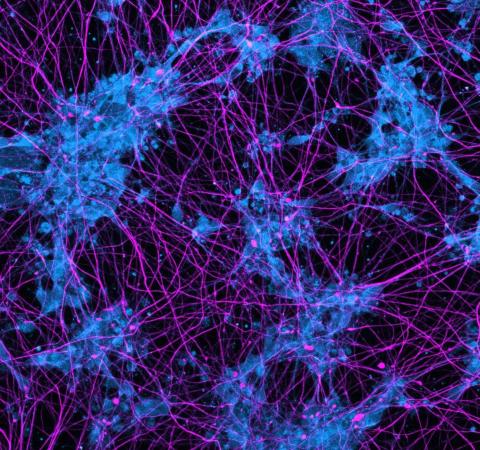
Neuronal cells. Credit: Hagemann, Serio Lab
Engineering neuroscience to learn more about neurodegeneration
Dr Andrea Serio’s lab aims to investigate local RNA processing, temporal and spatial dynamics of RNA binding proteins (RBPs) in axons and dendrites, and generally the role that local RNA dynamics plays in neuronal function and dysfunction. The main area of work will be local RNA processing and RNA regulation in axons and dendrites, their interplay with other metabolic pathways and role in early molecular pathology of ALS/FTD molecular pathology. They aim to identify usable targets to modulate downstream toxic events that leads to early stages of cellular toxicity.
Main objectives and research goals:
- Applying tools to understand the effect of axonal length on RBP localisation and local RNA translation in ALS patient derived motor neurons, using a combination of transcriptomic analysis and super resolution imaging (supported by a Motor Neuron Disease Association Biomedical Research Project grant)
- Discovering the molecular signalling behind the length-dependent axonal regulatory mechanisms and their effect on local translation in axons (supported by a BBSRC Responsive Mode grant).
- Developing a high-throughput version of the axonal platform that will allow to perform correlative live imaging and complex transcriptomic studies to specifically study the mechanisms of RNA compartmentalisation in different part of the axon and the effect of different RBP mutations on the axonal RNA component, in collaboration with Prof. Jernej Ule at the DRI/Francis Crick Institute.
- Extending studies to cross-species comparison, to understand how basic aspects of axonal metabolic and translational regulation are orchestrated within different model organisms relevant for ALS research (mouse, rat and zebrafish)
Key publications
Vacancies
-
Key details
- Location UK DRI at King's
- Salary: £39,076 - £43,909 per annum
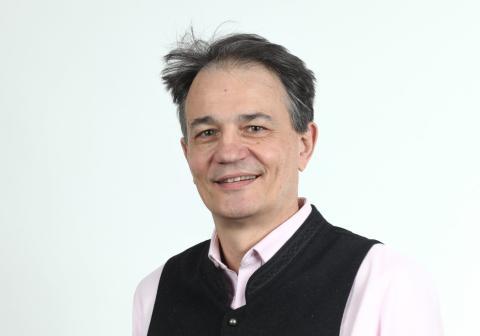
- Lab: Professor Marc-David Ruepp
About us
Dementia is one of the greatest health challenge of our century. To date there is no way to prevent it or even slow its progression, and there is an urgent need to fill the knowledge gap in our basic understanding of the diseases that cause it.The UK Dementia Research Institute (UK DRI) is the biggest UK initiative driving forward research to fill this gap.Researchers at the UK DRI at King’s use innovative approaches to explore the biological mechanisms involved in neurodegenerative diseases. Their goal is to defeat dementia by uncovering vital new knowledge that will lead to the design of smarter diagnostics and effective treatments. The team aim to understand the fundamental biological processes involved in dementia at a molecular level – and to use that knowledge to design new ways to diagnose and treat disease more precisely.Join the forefront of dementia research at the UK Dementia Research Institute (UK DRI) at King's College London, where our vibrant and interdisciplinary research community is dedicated to unravelling the complexities of with the most common types of motor neuron disease, amyotrophic lateral sclerosis, and frontotemporal dementia.As part of the Department of Basic and Clinical Neuroscience, the UK DRI at King’s focuses on innovative cellular, molecular, and computational research to advance our understanding of neurodegenerationAbout the role
We are seeking an experienced and proactive laboratory professional to oversee the shared operations of the UK Dementia Research Institute research groups led by Professor Marc-David Ruepp and Dr Andrea Serio. This is a pivotal, non-experimental role focused on ensuring smooth day-to-day running of the laboratories, maintaining compliance and safety, and supporting two dynamic research teams.The postholder will be the key point of contact for lab organisation — taking ownership of ordering, stock management, rota coordination, and enforcement of good laboratory practice. They will have the confidence to develop and implement necessary changes, while maintaining professional and constructive relationships across both teams.This role is ideal for an experienced technical professional with a strong background in laboratory management and operations. Applicants with a commitment to maintaining a high-performing, well-organised laboratory are strongly encouraged to apply. Applicants must have prior hands-on experience in similar technical roles, as this is essential for success. The position is focused on technical and operational responsibilities. Please note that it is not a pathway to a PhD and will not include training needed for a research-focused career.About you
To be successful in this role, we are looking for candidates to have the following skills and experience:Essential criteria- Extensive prior experience in coordinating day-to-day laboratory operations within a research, clinical, industrial, or equivalent technical environment, including responsibility for rota coordination, stock and inventory oversight, equipment maintenance scheduling, supplier liaison, facilities coordination, and purchasing processes.
- Demonstrated experience ensuring adherence to laboratory policies, procedures, and standards across staff and students who are not direct reports, including confidence in advising, instructing, and, where necessary, challenging or correcting practice to maintain a safe and compliant working environment.
- Proven capability to manage concurrent tasks and operational demands independently, exercising sound judgement, discretion, and appropriate escalation when necessary.
- Exceptional organisational skills and clear, professional communication, with consistent attention to accuracy and detail in documentation and record-keeping.
- Proven ability to deal with operational challenges constructively and diplomatically, supporting colleagues, resolving issues in real time, and contributing to continuous improvement in laboratory practices.
- Working knowledge of procurement and inventory systems, laboratory safety procedures, and relevant regulatory or compliance frameworks, with the ability to ensure these are maintained and updated in practice.
Desirable criteria- Prior experience supporting or managing multiple principal investigators or teams.
- Familiarity with biological or molecular biology laboratories.
- Experience in wet lab work
Lab members
- Dr Cathleen Hagemann (Postdoctoral Researcher)
- Dr Taylor Minckley (Postdoctoral Researcher)
- Dr Eugenia Carraro (Postdoctoral Researcher)
- Moreno Gonzalez (PhD student)
- Ludovica Guetta (PhD Student)
- Sofia Fredin (PhD Student)
- Magnus Jhaveri (PhD Student)
- Sofia Fredin (PhD Student)
- Edward Jhaveri (PhD Student)
- Martha Yates (PhD Student - Jointly with Jernej Ule)
Collaborators
Lab funders
Thank you to all those who support the Serio Lab!